







A Turkish entrepreneur submitted a €500,000 investment for Antigua and Barbuda citizenship in March 2025. Due diligence investigators flagged inconsistencies between declared income and the size of the investment portfolio. His application entered Enhanced Due Diligence review, extending the standard 60-day timeline to 11 months before final rejection for insufficient source-of-funds documentation.
Citizenship by investment due diligence is the comprehensive verification process that governments conduct to assess applicants’ identity, financial history, criminal records, and reputational risk before granting citizenship or residency. Programs screen source of funds, beneficial ownership, and sanctions exposure to prevent money laundering, terrorist financing, and reputational harm to the issuing country. For applicants, this means your personal and financial life will be scrutinized in detail—sometimes for months—before you know if your application succeeds.
Enhanced Due Diligence (EDD) — an elevated tier of investigation applied to high-risk applicants including Politically Exposed Persons (PEPs), nationals from sanctioned jurisdictions, or individuals making investments exceeding $1 million; EDD extends beyond basic background checks to include third-party verification, asset tracing, and field investigations per FATF Recommendation 16.
Over 20 countries currently offer residency or citizenship by investment programs as of 2026, spanning the Caribbean, Europe, the Middle East, Africa, and the Pacific. Our legal team has guided 340+ applicants through due diligence reviews across 12 jurisdictions since 2019, securing approvals in cases involving complex corporate structures, inherited wealth, and cross-border asset holdings.
What Exactly Is Due Diligence in Citizenship by Investment Programs?
Due diligence in citizenship by investment programs is a mandatory risk-assessment framework that citizenship authorities use to verify an applicant’s suitability for economic citizenship. The process integrates identity authentication, criminal background checks, sanctions screening, source-of-wealth analysis, and adverse media monitoring.
Customer due diligence procedures follow a risk-based approach mandated by the Financial Action Task Force (FATF) Recommendation 16, which requires countries to identify and verify the identity of customers and beneficial owners. Citizenship programs classify due diligence into two tiers:
- Standard Due Diligence (SDD): Applies to low-risk applicants with straightforward financial histories. You’ll submit identity documents, police certificates, and basic source-of-funds declarations. Most applications move through this track without delay.
- Enhanced Due Diligence (EDD): Triggered for applicants from high-risk jurisdictions, PEPs, or those making investments exceeding program-specific thresholds. Expect third-party investigations, bank reference letters covering 5–10 years, and beneficial ownership tracing through corporate structures. This path adds months to your timeline.
Governments contract licensed due diligence providers such as Thomson Reuters World-Check, Refinitiv, and specialized investment migration compliance firms to conduct independent background investigations. These providers access international databases including Interpol’s I-24/7 system, OFAC sanctions lists, UN Security Council consolidated lists, and adverse media archives spanning 240+ jurisdictions.
Why Do Citizenship by Investment Programs Require Such Strict Background Checks?
Citizenship by investment programs face genuine exposure to money laundering risk under FATF’s risk assessment methodology. The international body classifies economic citizenship schemes as vulnerable channels for illicit financial flows because they grant visa-free travel, banking access, and residency rights in exchange for capital investment. A single compromised applicant—someone later revealed to have ties to organized crime or sanctions evasion—can trigger international sanctions against the entire program.
Programs must implement Anti-Money Laundering (AML) compliance frameworks to meet international standards and avoid sanctions. The European Commission placed Cyprus and Malta under enhanced scrutiny in 2020 after identifying weak due diligence controls. Malta subsequently suspended its Individual Investor Programme for 12 months to reform verification procedures. That suspension cost applicants months of delay and forced the program to rebuild its reputation from scratch.
Countries offering citizenship risk reputational damage and visa reciprocity penalties if they admit applicants with criminal convictions, sanctions exposure, or links to terrorism financing. Vanuatu lost visa-free access to the European Union in 2022 after security reviews revealed inadequate due diligence in its Development Support Program. The consequences were immediate: citizens lost the ability to travel visa-free to 27 EU member states. Vanuatu reinstated visa privileges in 2023 only after implementing Enhanced Due Diligence protocols for all applicants—a painful lesson that due diligence failures cost entire nations.
From practice: Citizenship authorities share due diligence findings with financial intelligence units and foreign governments under mutual legal assistance treaties. An applicant rejected by Malta for insufficient source-of-funds documentation may face secondary scrutiny when applying for residency in Portugal or investment accounts in Switzerland. Your due diligence record follows you across jurisdictions.
What Are the Core Steps in the Due Diligence Process for Citizenship Applicants?
The due diligence investigation unfolds in five sequential stages. Each has specific documentary requirements and verification protocols, and each is a point where applications can stall:
Stage 1: Identity Verification and Biometric Screening
Applicants submit government-issued passports, national identity cards, and birth certificates. Citizenship units authenticate documents through diplomatic channels and cross-reference biometric data (photographs, fingerprints) against Interpol databases and national watchlists. Malta’s Citizenship by Investment Unit requires apostilled birth and marriage certificates authenticated by the applicant’s country of origin within 90 days of submission. If your home country’s authorities move slowly, this deadline becomes a real bottleneck—missing it triggers application delays while the unit waits for proper documentation.
Stage 2: Criminal Background and Sanctions Screening
Due diligence teams obtain police clearance certificates from every country where the applicant resided for 12+ months after age 18. Investigators screen names against OFAC Specially Designated Nationals (SDN) lists, UN Security Council consolidated lists, EU sanctions databases, and Interpol Red Notices. Antigua and Barbuda’s Citizenship by Investment Unit rejects applicants with criminal convictions punishable by imprisonment exceeding one year, regardless of whether sentences were served. Even a conviction decades in the past can trigger automatic rejection.
Stage 3: Source-of-Funds and Wealth Verification
Applicants provide detailed declarations explaining the origin of investment capital, supported by documentary evidence spanning 5–10 years. Acceptable documentation includes:
- Audited financial statements for business owners (certified by licensed accounting firms)
- Employment contracts, salary statements, and tax returns
- Inheritance documents: probated wills and estate distribution certificates
- Property sale agreements and capital gains records from real estate transactions
- Investment account statements showing portfolio growth and dividend income
St. Kitts and Nevis requires applicants investing $250,000+ to provide bank reference letters confirming account history, transaction patterns, and average balances for at least five years before application. A gap in your documentation—say, two years where you can’t explain where money came from—can trigger rejection. You won’t get a second chance to explain; the unit simply closes the file.
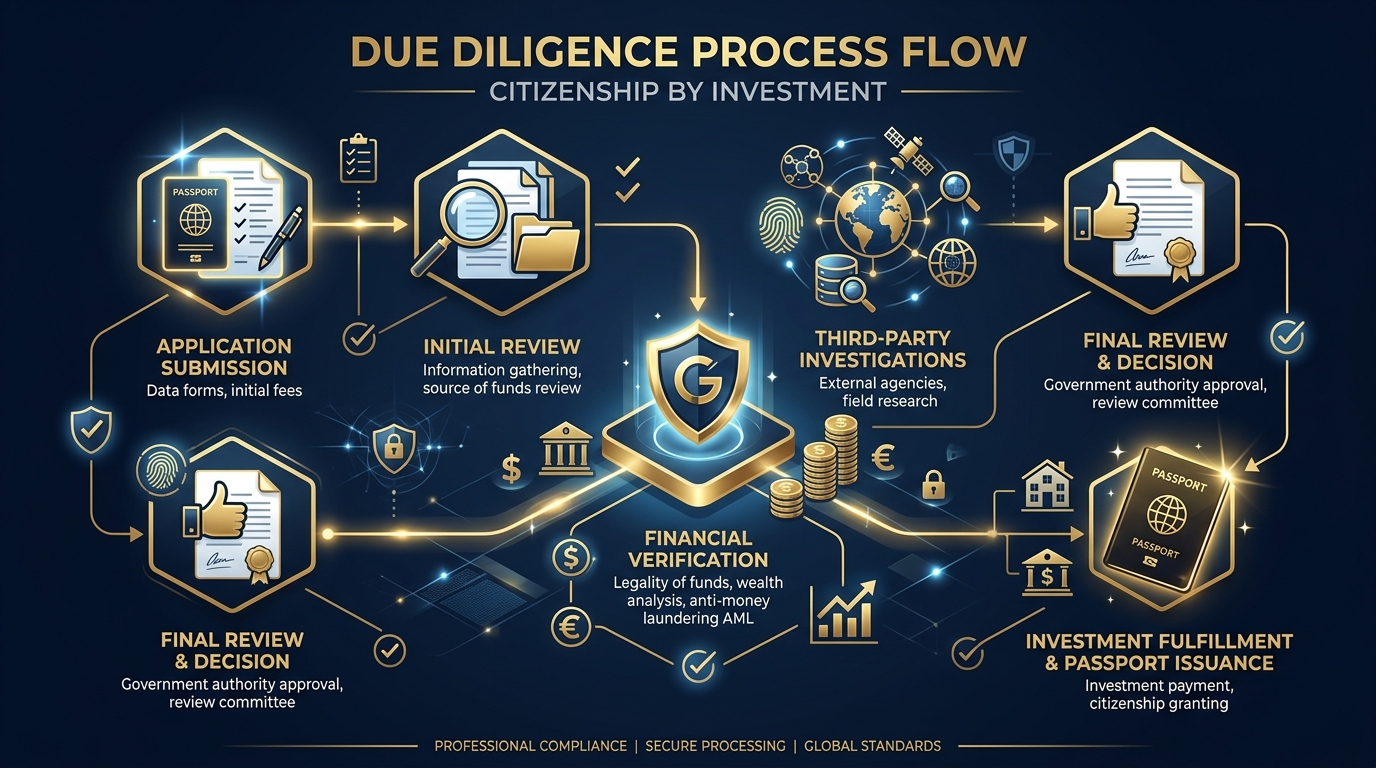
Stage 4: Enhanced Due Diligence for High-Risk Profiles
EDD investigations apply automatically to applicants meeting any of the following criteria:
- Nationals or residents of countries on FATF’s high-risk or increased monitoring lists (grey lists)
- Politically Exposed Persons as defined by FATF Recommendation 12: government officials, senior executives of state-owned enterprises, or close family members of PEPs
- Applicants making investments exceeding $1 million or involving complex corporate structures
- Individuals with adverse media coverage related to corruption, financial crime, or human rights violations
EDD extends timelines by 3–9 months and involves third-party field investigations, beneficial ownership tracing through nominee structures, and verification of commercial claims through business registries and trade databases. If you fall into this category, plan accordingly—your timeline doubles or triples.
Stage 5: Final Verification and Approval Decision
Citizenship boards review compiled due diligence reports and issue approval or rejection decisions. Grenada’s Citizenship by Investment Committee convenes monthly to adjudicate applications; approved applicants receive Certificates of Registration within 30 days of committee decision. Rejections include no right of appeal in most programs, and governments do not refund due diligence fees (typically $5,000–$10,000 per applicant). A rejection means you lose your investment in the application itself and cannot reapply to that jurisdiction for 12–24 months, depending on the program.
Which Red Flags Cause Due Diligence Teams to Reject Citizenship Applications?
Due diligence investigators apply strict exclusion criteria to protect program integrity. The following red flags trigger automatic rejection or extended investigation:
| Red Flag Category | Specific Triggers | Program Response |
|---|---|---|
| Criminal History | Convictions for money laundering, fraud, terrorism, drug trafficking, or crimes punishable by 1+ years imprisonment | Automatic rejection; no waiver available |
| Sanctions Exposure | Presence on OFAC SDN, UN, EU, or national sanctions lists; business ties to sanctioned entities | Automatic rejection; may trigger referral to financial intelligence units |
| Source-of-Funds Deficiencies | Inability to document wealth origin; inconsistencies between declared income and investment size; use of shell companies without legitimate business purpose | Request for additional documentation; rejection if unresolved within 30–60 days |
| PEP Status Without Disclosure | Failure to declare government positions, state-owned enterprise roles, or close family ties to PEPs | Rejection for material misrepresentation; potential fraud referral |
| Adverse Media | Credible investigative journalism linking applicant to corruption, organized crime, or human rights abuses | Extended EDD investigation; rejection if allegations substantiated |
| Prior Visa or Citizenship Refusals | Previous denial of citizenship, residency, or visa applications in Schengen Area, US, UK, Canada, or Australia | Enhanced scrutiny; rejection if refusal based on security, fraud, or misrepresentation grounds |
Dominica’s Citizenship by Investment Unit rejected 14% of applications in 2025, with 62% of rejections attributed to insufficient source-of-funds documentation and 23% to undisclosed criminal history, according to the government’s annual transparency report published in January 2026. Those are not edge cases—they represent the majority of rejections.
From practice: Applicants who use layered corporate structures to obscure beneficial ownership trigger immediate Enhanced Due Diligence. Citizenship units require full ownership disclosure up to ultimate beneficial owners holding 10%+ equity, even when corporate vehicles are domiciled in zero-tax jurisdictions with nominee shareholder provisions. Attempting to hide ownership doesn’t protect you; it accelerates rejection.
How Long Does Due Diligence Take, and What Deadlines Should Applicants Know?
Due diligence timelines vary by jurisdiction, applicant risk profile, and documentation quality. Processing periods across major citizenship by investment programs as of 2026 typically follow these patterns:
| Country | Minimum Investment | Standard Due Diligence Timeline | Enhanced Due Diligence Timeline |
|---|---|---|---|
| Antigua and Barbuda | $230,000 (National Development Fund) | 60–90 days | 6–9 months |
| Dominica | $200,000 (Economic Diversification Fund) | 90–120 days | 7–12 months |
| Grenada | $235,000 (National Transformation Fund) | 60–90 days | 6–10 months |
| Malta | €600,000 (3-year residency route) | 3–4 months | 8–14 months |
| St. Kitts and Nevis | $250,000 (Sustainable Island State Contribution) | 60–90 days | 5–9 months |
| St. Lucia | $240,000 (National Economic Fund) | 90–120 days | 7–11 months |
| Turkey | $400,000 (real estate investment) | 30–60 days | 4–8 months |
| Vanuatu | $130,000 (Development Support Program) | 30–60 days | 5–8 months |
Your response deadline matters more than you might think. Malta’s Community Malta Agency requires answers within 30 days—miss that window, and your application suspends. Go 90 days silent, and it closes entirely. No refund. St. Kitts has similar teeth, though slightly longer windows. What this means in practice: if citizenship authorities request documents on March 15, you cannot treat it casually. Calendar that 30-day mark and build in buffer time for mail delays or translation hiccups.
Speed varies wildly. Vanuatu and Turkey process straightforward cases in 30–45 and 45–60 days respectively, using streamlined protocols for applicants with clean backgrounds. Dominica offers the lowest entry price at $200,000, followed by St. Lucia at $240,000. Looking for cheap citizenship in Europe? Turkey costs $400,000 for real estate investment (though it straddles Europe and Asia geographically).
What Role Do Third-Party Investigators Play in Citizenship Due Diligence?
Citizenship programs don’t investigate applicants themselves. They hire independent firms—Thomson Reuters, Refinitiv, regional agencies—to dig deeper than government staff can manage alone. These investigators access databases, run watchlist checks, and perform field verification that would take months if left to state bureaucrats.
Here’s what third-party investigators actually do:
- Verify identity and authenticate documents using biometric systems, Interpol’s I-24/7 database, and forensic document analysis to catch forgeries.
- Trace asset sources through corporate registries, bank confirmations, and business records—typically modeling 10+ years of wealth accumulation.
- Screen against 800+ sanctions lists and Politically Exposed Person databases updated daily, plus law enforcement watchlists.
- Monitor 100,000+ news sources in 30+ languages for financial crime, corruption, organized crime, or human rights violations tied to your name.
- Send investigators into the field to verify business addresses, property claims, and commercial operations when documents raise red flags.
St. Kitts and Nevis requires third-party reports for every applicant investing $250,000 or higher. The Citizenship by Investment Unit contracts independent firms to produce risk assessments within 45 days of filing. These reports land on a citizenship committee’s desk with a recommendation: Approve, Reject, or Further Investigation Required. That recommendation typically determines the outcome.
Expect to pay $5,000–$15,000 per applicant for third-party due diligence, plus more for dependents or Enhanced Due Diligence work. These fees don’t come back regardless of what happens. For perspective: the U.S. has no direct citizenship-by-investment program. The EB-5 immigrant investor visa requires $800,000–$1,050,000 and leads to permanent residency, not citizenship.
Citizenship by Investment Application That Passes Enhanced Due Diligence?
Our legal team has guided 340+ applicants through due diligence reviews across 12 jurisdictions since 2019. We structure source-of-funds documentation, coordinate third-party verification, and manage complex cases involving corporate structures, inherited wealth, and PEP disclosures. For additional guidance, visit our services page.
Get consultation on citizenship by investment due diligence →
How Can Applicants Prepare Documentation to Pass Due Diligence Smoothly?
Due diligence success depends on three things: comprehensive financial records organized chronologically, understanding what investigators will actually look for, and professional guidance tailored to your program’s specific rules. Here’s how to build a bulletproof application:
Step 1: Compile a Complete Source-of-Funds Portfolio
Gather documents proving where every dollar came from. Investigators model wealth backwards, so they’ll want to see:
- Tax returns from the past 5–10 years, certified by tax authorities
- Audited financial statements (for business owners, prepared by licensed CPAs or chartered accountants)
- Employment contracts and salary statements plus reference letters from your employer
- Property sale agreements, title deeds, and capital gains records if you sold real estate
- Inheritance documents: probated wills, estate distribution certificates, inheritance tax filings
- Investment account statements from recognized banks showing portfolio growth and dividend income
- Business ownership certificates and shareholding records for entrepreneurial wealth
One critical rule: Malta requires you to hold investment funds in recognized financial institutions for at least 12 months before applying. This prevents the appearance of quickly shuffling money around to hide its origins.
Step 2: Obtain Police Clearance Certificates From All Residence Countries
For every country where you lived 12+ months since age 18, request a police certificate. They must be issued within three to six months of application (check your program’s rules—some require three). Get them apostilled under the 1961 Hague Convention if needed, and translate non-English documents officially.
Step 3: Prepare Detailed Business Ownership and Corporate Structure Charts
If your money comes from owning a business, draw out the full ownership chain from ultimate beneficial owners down to operating companies. Name every shareholder holding 10% or more. If you use nominee arrangements or offshore holding companies, explain the legitimate business purpose—and investigators will verify it. Vague structures trigger Enhanced Due Diligence.
Step 4: Disclose PEP Status and Government Connections
Have you held a government position? Sit on the board of a state-owned enterprise? Are your parents, spouse, or siblings in politics? Disclose it upfront. FATF defines PEPs as heads of state, senior politicians, senior officials, judges, military officers, executives of state-owned corporations, and prominent political party officials. Family members and close associates count too. Investigators will find these connections; admitting them early beats having it discovered and raising suspicion.
Step 5: Address Adverse Media and Prior Refusals Proactively
Negative news coverage or a prior visa denial? Don’t hide it. Due diligence teams will find it. Prepare a written explanation with supporting evidence and submit it before being asked. Context and transparency reduce the risk of rejection for material misrepresentation.
Step 6: Engage Professional Advisors With Jurisdiction-Specific Experience
Partner with a financial advisor for investment structuring, legal counsel specializing in citizenship due diligence, and a licensed migration agent registered with your target country. They’ll navigate program-specific quirks, coordinate with third-party investigators, and ensure you hit response deadlines without scrambling.
We guide applicants through comprehensive due diligence preparation in Antigua and Barbuda, Dominica, Grenada, Malta, St. Kitts and Nevis, St. Lucia, Turkey, and Vanuatu. That includes source-of-funds structuring, corporate ownership mapping, and direct liaison with citizenship authorities.
How Do Caribbean, European, and Middle Eastern Citizenship Programs Compare on Due Diligence Standards?
Rigor differs sharply by region. Caribbean programs move fastest; European programs dig deepest; Middle Eastern routes offer tax benefits. Here’s what distinguishes them:
| Region | Typical Due Diligence Features | Processing Timeline | Key Advantage |
|---|---|---|---|
| Caribbean (Antigua, Dominica, Grenada, St. Kitts, St. Lucia) | Four-tier risk framework; mandatory third-party investigations for $250,000+ investments; CARICOM information sharing | 60–120 days standard | Fastest processing; visa-free access to Schengen Area, UK (varies by country) |
| Europe (Malta, Turkey) | EU coordination for Malta (Europol database checks); mandatory residency verification; stricter PEP screening | 90–180 days standard | EU citizenship (Malta) or European residency pathway (Turkey) |
| Middle East (UAE residence by investment) | Biometric screening; financial intelligence unit cooperation; Emirates ID integration | 30–60 days for Golden Visa | Tax residency benefits; access to Gulf Cooperation Council markets |
| Pacific (Vanuatu) | Reformed protocols post-EU visa suspension; Enhanced Due Diligence for all PEPs; mandatory third-party reports | 30–90 days standard | Fastest approval; zero income tax jurisdiction |
| Africa (no direct citizenship by investment) | N/A – no current programs offering direct citizenship for passive investment | N/A | N/A |
Africa has no direct citizenship-by-investment programs. South Africa and Rwanda grant residency for investors but require 5–10 years of naturalization before citizenship. Free citizenship routes exist elsewhere: Italy, Ireland, and Poland offer citizenship through ancestry; many countries grant it through marriage (usually 2–3 years) or after 5–10 years of residence.
Malta runs Europe’s strictest due diligence. You must live there 12–36 months (depending on investment tier) before gaining citizenship. Malta’s Community Malta Agency coordinates with Europol, EU intelligence services, and financial crime authorities across member states to vet applicants.
What Investment Strategies Help Applicants Structure Compliant Source-of-Funds Documentation?
If your wealth comes from business, inheritance, or investments, you’ll need to prove where it came from—and prove it convincingly. Investment professionals who work on citizenship applications recommend these strategies to build documentation that satisfies due diligence teams:
Consolidate Wealth Into Transparent Investment Accounts
Move your investment capital into accounts at regulated banks with full AML compliance frameworks. Start this 12–24 months before filing your application. Accounts must be in your name or jointly held with disclosed family members. Avoid nominee accounts or bearer instruments—due diligence teams see these as warning signs.
Use established institutions: Chase investment account services, HSBC private banking, or regional equivalents with documented audit trails. The longer your money sits visibly in these accounts before application, the harder it is for investigators to claim the funds were hastily assembled to meet citizenship minimums.
Document All Fund Transfers With Wire References
Track every dollar moving from source (salary accounts, business accounts, asset sale proceeds) to investment accounts. Keep wire transfer records showing sending bank, receiving bank, transfer date, amount, and purpose reference.
What goes wrong here: applicants often lose early transfer records or use informal transfers (cash deposits, personal checks from years ago). If you can’t trace the money back to its origin, investigators assume you’re hiding something—even if you’re not.
Structure Business Ownership Through Transparent Corporate Vehicles
Wealth from business ownership needs clear organizational structure. Due diligence teams view complex holding company structures involving offshore jurisdictions as red flags unless legitimate business purposes exist (multinational operations, IP licensing, tax-efficient but legal structures).
The exception: if your business actually operates internationally or manages intellectual property across borders, document that clearly. But five layers of shell companies in tax havens? That raises questions.
Engage Licensed Accounting Firms for Financial Statement Audits
Get audited financial statements for all businesses contributing to your investment wealth. Use licensed CPAs, chartered accountants, or professionals recognized in your home jurisdiction. Audits must follow International Financial Reporting Standards (IFRS) or Generally Accepted Accounting Principles (GAAP).
Missing this step costs you credibility. Self-prepared statements or unsigned tax forms invite deeper questioning about whether your business even existed or generated the income you claim.
Prepare Tax Compliance Records Spanning 5–10 Years
Organize certified tax returns covering your full wealth accumulation period. Investigators cross-reference declared income against investment size to spot inconsistencies. If your stated income doesn’t explain how you accumulated $1 million, you need supplementary documentation: inheritance records, asset sale agreements, investment portfolio statements showing gains.
If you can’t explain the gap? Your application stalls while they investigate—adding months to your timeline and signaling potential problems to the citizenship authority.
Work With Financial Advisors for Investment Portfolio Diversification
Financial advisors help optimize capital across bonds, equities, and real estate—demonstrating legitimate wealth management rather than suspicious concentration. Portfolio diversification through recognized investment funds, institutional vehicles like fortress investment group or cetera investment services, adds credibility to your source-of-funds narrative.
For Abu Dhabi applicants, advisors familiar with abu dhabi investment authority standards ensure your documentation meets international transparency benchmarks. Applicants using established platforms build audit trails that satisfy Enhanced Due Diligence requirements on their own.
Our team collaborates with licensed financial advisors, certified accountants, and investment professionals to structure compliant source-of-funds portfolios. We’ve guided applicants whose wealth originated in real estate operations, technology startups, and family offices managing diversified holdings. For guidance tailored to your situation, contact our legal team.
This article is published by an independent law firm for informational purposes only and does not represent or claim affiliation with any government body, international organization, or official authority.