






Citizenship by Investment Lawyers
Citizenship by investment is one of the fastest legal routes to a second passport, but the details vary sharply by country. Some programs focus on a direct donation or real estate route, while others lean more heavily on residence, merit, or a broader naturalization path. For country-level detail, see Malta, Grenada, Dominica, Saint Lucia, Vanuatu, and Egypt.
Citizenship by investment is one of the fastest legal routes to a second passport, but the details vary sharply by country. Some programs focus on a direct donation or real estate route, while others lean more heavily on residence, merit, or a broader naturalization path.
For country-level detail, see Malta, Grenada, Dominica, Saint Lucia, Vanuatu, and Egypt.
This hub is designed to help you compare the main options side by side before you commit to an application.
Do You Need a Citizenship by Investment Lawyer?
A citizenship by investment lawyer structures your application so it survives due diligence: confirming eligibility, documenting the lawful source of your funds, preparing dependants’ files, and filing through an authorised government agent. Legal help is not required for every program, but it becomes decisive when your case involves prior loss of nationality, military service, tax exposure, sanctions screening, or a discretionary route such as Malta. The lawyer’s job is to match the right program to your situation and to prevent a refusal, which is far harder to reverse than to avoid. Our attorneys review each case before filing and confirm whether a citizenship-by-investment route is the correct fit.
How to compare programs in practice
The right route is not just the one with the shortest marketing brochure. It is the one that matches your real-life needs, including family size, your source of funds, the urgency of travel, and whether you want a simple second passport or a broader relocation plan.
When comparing countries, check the due diligence level, whether dependants can be included cleanly, and how much extra documentation you will need to prepare. A route that looks simple at first can become slow or expensive if the file is not ready.
What to ask before filing
- How fast is the realistic approval time for a clean file?
- Can my spouse, children, or parents be included?
- What is the total cost once legal and due diligence fees are included?
- Does the route give direct citizenship or start with residence?
- How does the passport fit my travel and business goals?
Why some programs need a separate review
Malta deserves separate treatment because the classic investor model is no longer a simple fixed-price citizenship sale. The route is more discretionary, so applicants should read it as a merit-based system rather than assuming it works like the Caribbean programs.
Egypt is also worth separating from the Caribbean pages, because it gives readers a different comparison point and shows how investor-citizenship planning can vary outside the usual island shortlist.
If you are still deciding whether you need a second passport for mobility, taxes, family planning, or business access, start with the country pages below and then review the dual citizenship guide for the legal background.
🌍 CITIZENSHIP BY INVESTMENT COMPARISON
Compare Programs and Calculate Total Application Costs
Our international attorneys will help you evaluate Caribbean, European, and Pacific programs, structure your source of funds for strict due diligence, and choose the most cost-effective route for your family.
Main citizenship by investment routes
The most useful comparison is not simply the cheapest program. The right choice depends on speed, family inclusion, travel access, tax profile, and how much documentation you want to prepare in advance. Malta should also be treated carefully, because the old classic model has been replaced by a merit-based route rather than a simple purchase of citizenship.
Which citizenship by investment program is best?
No single program is best for every applicant. The answer depends on four factors: budget, timeline, passport strength, and whether the family structure complicates the due diligence review.
For budget-conscious applicants, Dominica and Saint Lucia start at $100,000 (single applicant, non-refundable contribution). Processing typically runs three to six months. Passport access covers 140+ countries. For applicants who prioritize passport strength over cost, Malta and Vanuatu offer significantly better global access — Malta as an EU passport, Vanuatu for its speed at 30–60 days — at higher price points. Grenada uniquely grants access to the US E-2 Investor Treaty, which none of the other Caribbean programs provide.
Citizenship by investment programs: cost and comparison 2026
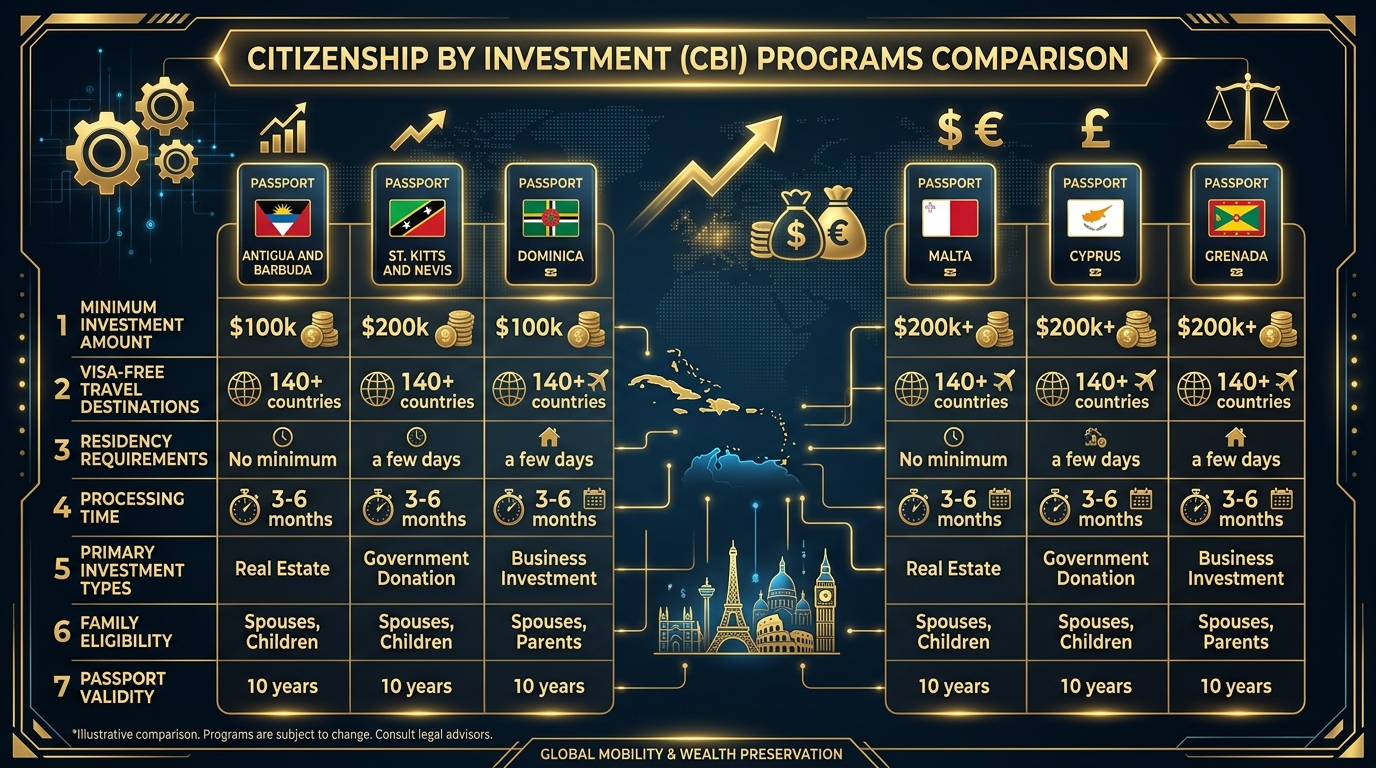
| Program | Minimum investment | Timeline | Visa-free countries | Key advantage |
|---|---|---|---|---|
| Dominica | $100,000 (single) | 3–6 months | 140+ | Lowest entry cost, strong CARICOM program |
| Saint Lucia | $100,000 (single) | 3–4 months | 140+ | Competitive timeline, US visa possible |
| Antigua and Barbuda | $100,000 (family of 4) | 3–5 months | 150+ | Family-friendly pricing |
| Grenada | $150,000 (single) | 4–6 months | 140+ | US E-2 Treaty access; only Caribbean program with this |
| St. Kitts and Nevis | $250,000 (SGF, single) | 4–6 months (45 days AIPP) | 150+ | Oldest program; accelerated option available |
| Vanuatu | $130,000 (single) | 30–60 days | 96+ | Fastest issuance globally; no residence required |
| Malta | €600,000 + donation | 12–14 months | 185+ (EU passport) | Full EU citizenship; strongest passport in CBI market |
Note: Prices are approximate minimum entry points for a single adult applicant. Family pricing, due diligence fees, government fees, and legal costs are additional. Always verify current program conditions before filing.
How much does citizenship by investment cost?
The headline investment figure is not the total cost. Every program adds government processing fees, due diligence fees (per applicant and per adult dependant), certificate fees, and passport fees. Legal and agent fees are separate. A realistic total for a Dominica or Saint Lucia application for a single applicant runs $130,000 to $160,000. For Grenada with a family of four, expect $250,000 to $320,000 all-in. Malta is in a different category entirely — the minimum contribution plus mandatory donation plus real estate link makes the realistic entry point €750,000 to €1,000,000 or more for a single applicant before professional fees.
Real estate options (where available) differ from donation options in one important way: real estate investments can sometimes be resold after the mandated holding period, partially recovering the outlay. Contribution routes are non-refundable by design. The program type — donation versus investment — affects both the upfront cost and the long-term financial outcome.
Countries that offer citizenship by investment
The active direct CBI programs in 2026 include:
- Caribbean: Dominica, Saint Lucia, Grenada, Antigua and Barbuda, St. Kitts and Nevis
- Pacific: Vanuatu
- Europe: Malta (only remaining EU direct CBI program)
- Europe (residence-to-citizenship): Bulgaria (5 years), Latvia (10 years), Montenegro (10 years), Germany (5 years)
Jordan, Turkey, and Egypt also operate residence-by-investment programs with citizenship available through naturalization, but these are less commonly used for second passport planning by international investors.
How to compare programs properly
When two programs look similar on the surface, the deciding factors are usually hidden in the fine print. Look at the minimum contribution, real estate requirement, due diligence stage, family coverage, processing time, and whether the route gives citizenship directly or begins with residence first.
- Timeline: how quickly the route can realistically be completed.
- Family inclusion: whether spouses, children, and dependent parents can be added.
- Travel value: what the passport actually gives you after approval.
- Compliance: how strict the source-of-funds and background checks are.
- Exit plan: whether the route fits your long-term tax and residence strategy.
If your main goal is not investment citizenship but country-specific dual nationality planning, the dual citizenship guide is the better starting point. That page explains the legal limits by country and helps you avoid mixing up unrelated legal regimes.
When to contact a lawyer
You should get legal advice before filing if you are dealing with military service, prior nationality loss, tax exposure, family members, or a country that treats citizenship as a discretionary exception. A bad filing choice can slow the process or create problems that are much harder to fix later.
For a direct review of your case, use the contact page and send your nationality, target country, and timeline. We can then narrow the route and tell you whether a citizenship-by-investment path is actually the right fit.