



Bulgarian Citizenship by Investment: Golden Visa & Naturalization Guide 2026
Bulgaria does not issue passports in exchange for investment contributions. The direct citizenship-by-investment route was closed in 2022 following amendments to the Bulgarian Citizenship Act under EU pressure. What exists today is a residency-by-investment program — the Bulgarian Golden Visa — which grants permanent residency immediately upon qualifying investment, with citizenship available through naturalization after…
Bulgaria does not issue passports in exchange for investment contributions. The direct citizenship-by-investment route was closed in 2022 following amendments to the Bulgarian Citizenship Act under EU pressure. What exists today is a residency-by-investment program — the Bulgarian Golden Visa — which grants permanent residency immediately upon qualifying investment, with citizenship available through naturalization after five years.
Bulgaria joined the Schengen Area in full on 31 March 2024. This changes the practical value of both Bulgarian residency and citizenship significantly. Compare CBI programs or explore the Citizenship Country hub for other European routes.
What Bulgaria’s Golden Visa actually offers
The current Bulgarian Immigrant Investor Program (BIIP), relaunched in its revised form after the 2022 reforms, issues permanent residence permits — not citizenship. The distinction matters. Permanent residence gives the holder the right to live and work in Bulgaria and, from 2024, to travel throughout the Schengen Area without visa restrictions. Citizenship comes later, after five continuous years of maintained permanent residence and meeting the naturalization requirements under the Citizenship Act.
The minimum qualifying investment is €512,000 (approximately 1,000,000 BGN at the fixed exchange rate of 1.95583 BGN/EUR). This must be held for the full five-year period to maintain the permanent residence permit and satisfy the investment condition for naturalization. Withdrawing or liquidating the investment before the citizenship application disrupts the entire process.
How to get Bulgarian citizenship through the investor route: step by step
Step 1: Select a qualifying investment vehicle. The Bulgarian Financial Supervision Commission licenses the investment options. The most common route is shares in alternative investment funds (AIFs) or exchange-traded funds focused on Bulgarian companies — the minimum for this route is €512,000. Other options include investment in an existing Bulgarian company capital (creating at least ten full-time jobs verified by the Ministry of Economy), investment in a new company as majority shareholder, or acquisition of rights under government concession agreements. Priority investment projects require a higher threshold of 2,000,000 BGN (approximately €1,024,000).
Step 2: Pass due diligence and obtain BIA pre-approval. The Bulgarian Investment Agency (BIA) conducts background checks before the investment is accepted. The review covers criminal record, source of funds, identity verification, and professional background. All documentation must be notarised and apostilled. Processing at this stage typically takes two to four weeks.
Step 3: Transfer the investment. Following BIA pre-approval, the qualifying amount is transferred through a Bulgarian-licensed bank. The transfer must be documented completely — bank confirmations, fund confirmation letters, and investment agreements form part of the application file.
Step 4: Receive the Investment Certificate and apply for a D Visa. The BIA issues an Investment Certificate following confirmed transfer. The investor then applies for a Bulgarian Investment Visa (D Visa) at the Bulgarian embassy or consulate in their country of residence. Visa processing typically takes one to three months.
Step 5: Enter Bulgaria and register for Permanent Residency. Following D Visa issuance, the investor enters Bulgaria and files for permanent residence. The full process from initial due diligence to residence card issuance typically takes six to nine months. Family members — spouse, minor children, and in some cases parents — may be included.
Step 6: Maintain investment and residence for five years. The investment must remain intact throughout the five-year period. During this time, the investor builds the continuous lawful residence record required for naturalization. There are no minimum annual presence requirements for the residence permit itself, but naturalization conditions require demonstrated integration.
Step 7: Apply for naturalization. After five years of permanent residence with maintained investment, the investor may apply for Bulgarian citizenship. The application goes to the Ministry of Justice and requires: proof of continuous permanent residence, investment maintenance documentation, a Bulgarian language test certificate (minimum A1/A2 level), clean criminal record from all countries of prior residence, and evidence of integration. Applicants must renounce their prior citizenship before Bulgarian nationality is issued.
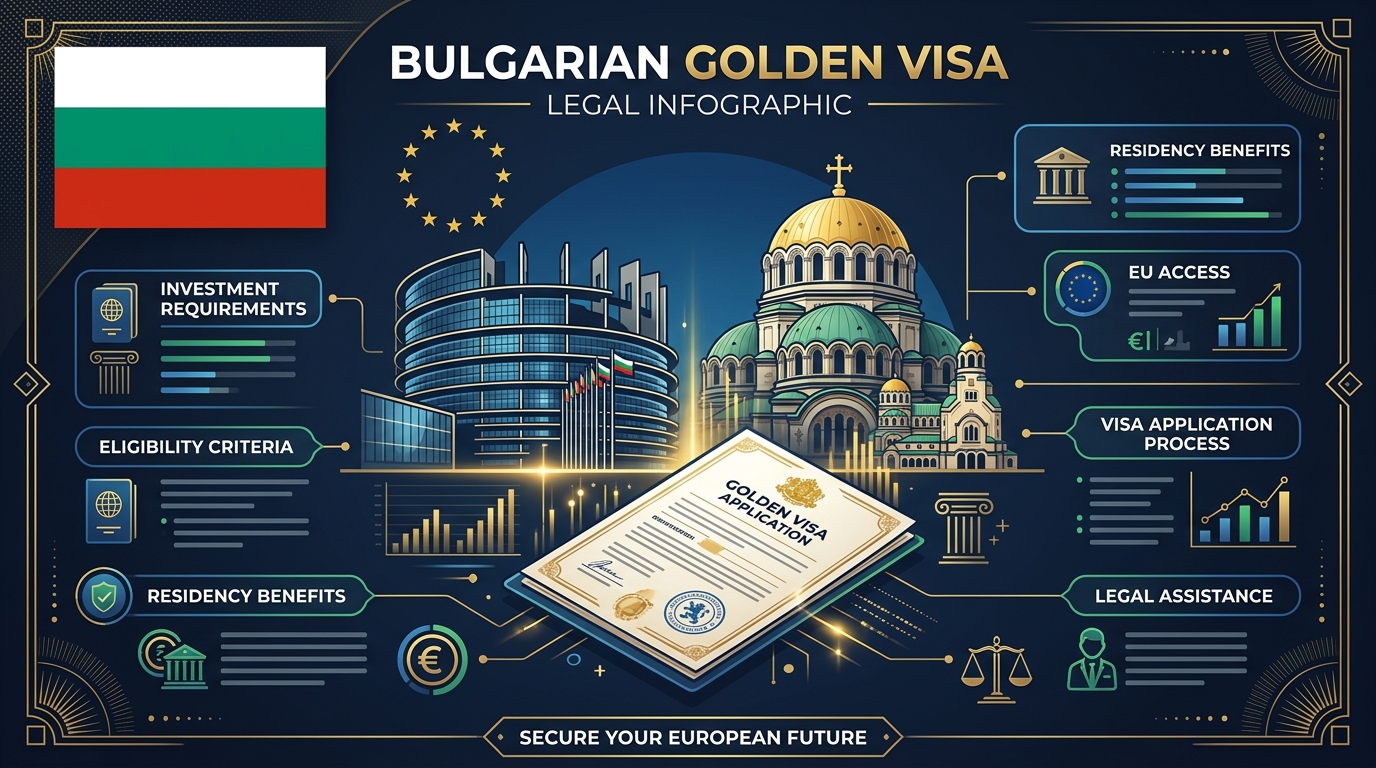
Bulgarian Golden Visa: investment options and thresholds
| Investment type | Minimum amount | Additional condition |
|---|---|---|
| Alternative Investment Funds / ETFs (Bulgarian companies) | €512,000 / 1,000,000 BGN | FSC-licensed fund; most common route |
| Existing Bulgarian company capital | €512,000 / 1,000,000 BGN | Must create ≥10 full-time jobs |
| New Bulgarian company (majority shareholder) | €512,000 / 1,000,000 BGN | Ministry of Economy verification |
| Government concession rights | €512,000 / 1,000,000 BGN | BIA approval required |
| Priority investment project shares | €1,024,000 / 2,000,000 BGN | Ministry of Economy priority designation |
All investments must be maintained for the full five-year residence period. Early liquidation forfeits the residency basis and resets eligibility for naturalization.
Timeline from investment to Bulgarian citizenship
| Stage | Duration | Key milestone |
|---|---|---|
| Due diligence and BIA pre-approval | 2–4 weeks | BIA clearance |
| Investment transfer and certificate | 2–4 weeks | BIA Investment Certificate |
| D Visa processing | 1–3 months | Embassy approval |
| Permanent residence registration in Bulgaria | Weeks after entry | Residence card issued |
| Maintained residence and investment | 5 years | Continuous PR record |
| Naturalization application and review | 6–12 months | Ministry of Justice decision |
| Bulgarian citizenship issued | Year 6–7 from start | Renunciation of prior citizenship required |
What naturalization in Bulgaria actually requires
The language requirement is not demanding by European standards. A1/A2 proficiency in Bulgarian is sufficient — roughly the level needed for basic everyday communication. Candidates who cannot meet this through study may qualify for an exemption based on age or documented health condition. The requirement exists in law but is not a barrier for most applicants who prepare in advance.
The criminal record requirement covers all countries where the applicant has lived for twelve months or more. Certificates must be current (typically no older than three months at the time of application) and authenticated. A single conviction for a minor matter may or may not be disqualifying — the Ministry of Justice reviews each case individually.
The renunciation of prior citizenship is the most significant personal decision in the Bulgarian naturalization process. Bulgaria does not permit dual nationality for naturalised citizens. The applicant must formally renounce their original citizenship before the Bulgarian passport is issued. For nationals of countries where citizenship cannot easily be re-acquired, this deserves careful legal assessment before the investment is made.
Why Bulgaria’s Schengen accession changes the calculation
Before March 2024, Bulgarian permanent residents and citizens could travel within Schengen only with valid Schengen visas. That is no longer the case. Bulgaria’s full Schengen accession means Bulgarian permanent residents now have free movement throughout the Schengen Area — and Bulgarian citizens hold an EU passport with unrestricted access to all 27 EU member states plus Iceland, Liechtenstein, Norway, and Switzerland.
The Bulgarian passport ranks roughly fifteenth to twentieth globally for travel freedom — visa-free or visa-on-arrival access to approximately 170 to 175 countries, including the UK, Canada, and Australia. As an EU document, it also carries consular protection rights from any EU embassy worldwide.